Homeowner Guide · System-First Diagnosis
A practical framework for figuring out what’s actually wrong with your house — and whether it can wait.
The Priority Scale Used Throughout This Guide
Most homeowners don’t actually want a contractor. They want an answer. Is that crack in the drywall something to worry about, or did the house just settle a little over the summer? Is the air conditioner blowing warm air because the filter’s dirty, or because the compressor is dying? And if it comes to that, will insurance help pay for any of it, or is this coming out of pocket either way?
The trouble is that “call someone” isn’t really a first step. It’s usually the third or fourth one. Before you pick up the phone, it helps to know which system you’re actually dealing with, how urgent it looks right now, and what’s worth photographing or writing down in case you need it later — for a contractor, an inspector, or an insurance adjuster.
That’s the whole idea behind diagnosing a home problem by system instead of by panic. Sort the issue by which part of the house it belongs to — foundation, HVAC, electrical, moisture, or a coverage question — and by how serious it looks today. Once you know both, the next step is usually obvious.
Three Questions to Ask Before You Do Anything Else
Before going system by system, run through the same three questions every time.
- What are you actually seeing, hearing, or smelling? “The house feels off” isn’t a symptom you can act on. “There’s a hairline crack running diagonally from the window corner” is.
- Which system does this belong to? Structural, cooling, electrical, moisture, or a documentation question for your insurer.
- Does it need attention today, soon, or just a bit of watching? That last question trips up more homeowners than the first two combined, which is why it gets its own scale.
Foundation Repair: Cracks, Settling, and Sticking Doors
Usually Fix SoonFoundation problems tend to announce themselves quietly — a door that used to close fine and now sticks, a crack running along a drywall seam, a floor that seems to slope slightly toward one corner of a room.
Not every crack means foundation repair is coming. Hairline cracks under about a sixteenth of an inch, especially vertical ones, are common as houses settle and usually belong in the “monitor” category. What changes the picture is width — anything wider than a pencil — direction (horizontal or stair-step cracks in block foundations are more concerning than vertical ones), and whether it’s visibly getting worse over a few weeks.
Before calling anyone, take dated photos, measure the crack if you can, and check whether doors and windows nearby have started sticking too. That combination — cracking plus doors and windows that no longer close right — is usually what moves foundation repair from “keep an eye on it” to “get it looked at soon.” Knowing the difference between a cosmetic crack and a structural one is also the easiest way to tell whether a foundation repair cost estimate is reasonable or inflated.
Full guide: foundation repair cost, crack severity, and when to call a specialist →Does Home Insurance Cover AC, HVAC, or Furnace Problems?
Document FirstThis is the question that trips people up the most, because home insurance coverage usually depends on the cause of the damage, not the type of damage.
A frozen pipe that bursts and floods a utility closet is often covered, because it’s sudden and accidental. A furnace that finally gives out after twelve years of normal use typically isn’t, because insurance is built around sudden, accidental events rather than maintenance and age. The same logic applies to AC systems — a compressor damaged by a fallen tree branch is a very different claim than one that failed after years of skipped filter changes.
This is exactly why documentation matters before you call your insurer, not after. Maintenance records, photos of the unit’s condition, and a clear timeline of when the problem started can be the difference between a covered claim and a denied one. If you’re not sure whether your situation looks like sudden damage or gradual wear, it’s worth figuring that out before you file anything.
Full guide: does home insurance cover AC, HVAC, and furnace problems? →Home AC Not Cooling: What to Check Before Calling a Technician
Fix SoonA warm-air AC is one of the most common calls a home service company gets — and a fair share of those calls turn out to be something a homeowner could have checked in five minutes.
Start with the thermostat setting and battery, then the air filter. A clogged filter is genuinely one of the most common causes of weak or absent cooling, and it’s the cheapest fix on this entire list. From there, check the outdoor condenser for leaves, debris, or anything blocking airflow, and make sure indoor vents are actually open and not blocked by furniture or rugs.
If the system is running but still not cooling, if you hear grinding or clicking from the outdoor unit, or if water is pooling near the indoor unit, that’s a different situation. Those symptoms usually point to a compressor, refrigerant, or drainage problem — worth a technician visit rather than more troubleshooting.
Full guide: home AC not cooling — quick checks before calling repair →Home Electrical Panel Problems: Warning Signs Not to Ignore
Act NowElectrical panel issues are the one category here where “wait and see” is rarely the right call, because the failure modes involve fire risk, not just inconvenience.
Warning signs worth taking seriously include a burning or “hot plastic” smell near the panel, a breaker that trips repeatedly even after you’ve unplugged everything on that circuit, visible rust or water staining on or near the panel, a buzzing sound, or a breaker that feels warm to the touch. Any one of these is a reason to stop investigating yourself and call a licensed electrician the same day, not schedule it for next week.
This is one of the few places in this guide where we won’t walk through DIY steps beyond basic observation, because getting it wrong carries real risk. The goal isn’t to diagnose the exact fault yourself — it’s to recognize which signs mean “keep watching” and which mean “this doesn’t wait.”
Full guide: home electrical panel warning signs and when to call an electrician →Mold in the Home: Signs, Sources, and What Needs Testing
Monitor → Act NowMold is a little different from the other systems here, because it’s usually a symptom of a different problem — a slow leak, poor bathroom ventilation, a humid crawl space — rather than an issue on its own.
Small, visible mold on bathroom tile or a windowsill is usually a moisture-management issue you can handle with better ventilation and regular cleaning. What changes the picture is mold showing up somewhere that shouldn’t be damp at all — behind furniture on an exterior wall, along baseboards, or a persistent musty smell in a room with no obvious source. That pattern usually means there’s a hidden moisture source, and finding it matters more than treating the mold you can see.
If anyone in the home has unexplained respiratory symptoms that ease up when they’re away from the house, or if you’re dealing with mold after a flood or a major leak, that’s worth a professional inspection rather than a DIY moisture fix.
Full guide: mold in the home — signs, sources, and when to get it inspected →Seasonal Home Maintenance Checklist: Preventing All Five at Once
A lot of what shows up above is preventable, and prevention tends to follow the seasons.
Check grading and drainage around the foundation, and get the AC looked at before the first real heat wave.
Watch indoor humidity and basement moisture — this is peak mold season.
Clean gutters, change HVAC filters, and walk the property looking for anything that changed over summer.
Check furnace function early, and know where your main water shutoff is before a pipe has the chance to freeze.
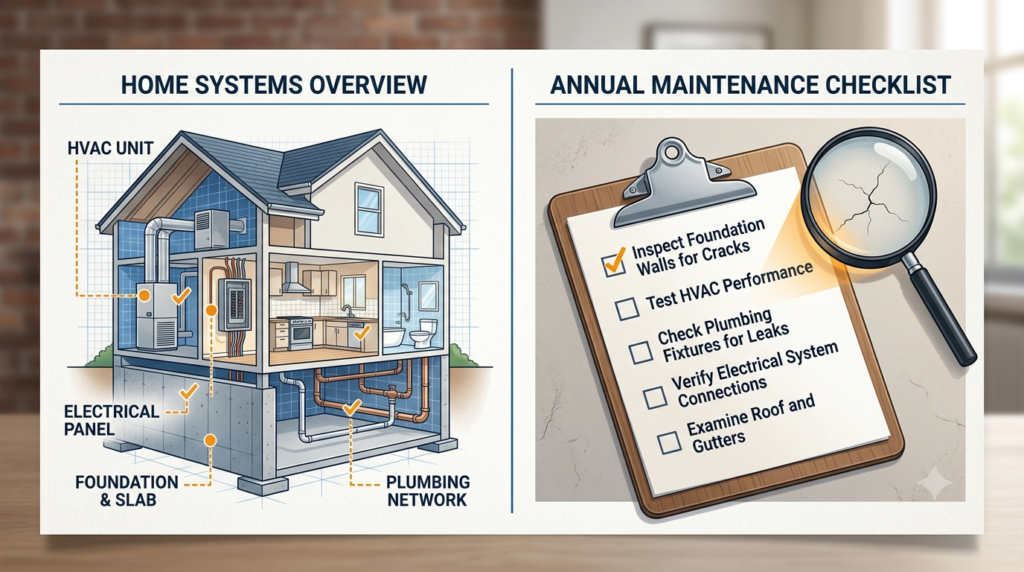
Keeping a simple seasonal checklist, along with dated photos of anything you’re monitoring, does two things at once: it keeps small issues from becoming expensive ones, and it gives you a paper trail if you ever do need to file a claim.
Full guide: seasonal home maintenance checklist →When to Stop Reading and Call a Professional
Guides like this one are useful for the first ninety percent of the decision — figuring out which system is involved and how urgent it looks. They’re not a substitute for a licensed contractor, an electrician, or your insurance provider, especially once something crosses into “act now” territory.
If you’re dealing with anything structural, electrical, water-related, or connected to a possible insurance claim, the safest move is the same one every section above points toward: document what you’re seeing, stop any DIY work, and bring in a professional before you go further.
Reader note: HomeDiagnosed gives general homeowner guidance. For structural, electrical, safety, or claim decisions, speak with a qualified professional or your insurer.
Start with the system, not the symptom — then jump to the guide that matches what you’re actually seeing.