Foundation Guide · homediagnosed.com
Foundation Crack Repair: What the Damage Means and What It Costs
How to read a crack before you panic, what repair actually involves, and what it should cost at each stage.
The Priority Scale Used Throughout HomeDiagnosed
A crack in your foundation is one of those things that looks a lot scarier than it usually is. Most homeowners see a line in the drywall or a gap along the baseboard and immediately think about five-figure repair bills. In reality, the vast majority of foundation cracks are cosmetic — the ordinary result of concrete curing, seasonal soil movement, or a house settling slightly in its first few years.
The problem is that “most cracks are fine” isn’t useful information on its own, because some aren’t fine, and the two can look similar to an untrained eye. What actually matters is being able to read a crack: its width, its direction, where it sits, and whether it’s part of a pattern with other symptoms in the house. Get that right, and you’ll know whether you’re looking at a $300 tube of epoxy or a $15,000 underpinning job before a contractor ever walks through the door.
Not All Cracks Are Foundation Cracks
Before going further, it’s worth separating two things that get lumped together constantly: drywall cracks and foundation cracks.
A crack in interior drywall, especially near a doorway or ceiling corner, is often just the house flexing with humidity and temperature changes — cosmetic, and usually solved for good with re-taping or paint. A foundation crack, by contrast, is a crack in the concrete, block, or brick the house actually sits on — in a basement wall, a crawl space footing, or a visible slab edge.
If you’re not sure which one you’re looking at, location is the giveaway. Interior drywall cracks that don’t correspond to anything visible in the basement or crawl space below are almost always cosmetic. This guide is about the second kind — cracks in the structure itself.
Reading the Crack: Width, Direction, and Pattern
Once you’ve confirmed it’s a structural crack, four things tell you almost everything you need to know.
Width. Anything under about 1/16 inch — roughly the thickness of a credit card edge — is considered hairline and rarely indicates active movement. Cracks between 1/16 and 1/4 inch deserve monitoring. Anything wider than 1/4 inch, or one you could fit a coin into, points toward active settling or pressure and moves you toward “fix soon” territory right away.
Direction. Vertical cracks are the most common and usually the least concerning — they typically follow natural concrete shrinkage as it cures. Diagonal cracks, especially ones running from the corner of a window or door, often indicate uneven settling on one side of the foundation. Horizontal cracks deserve the most attention, because they usually mean something is pushing against the wall from outside — commonly expansive soil or water pressure — and that force doesn’t resolve on its own.
Pattern. In block or brick foundations, a “stair-step” crack that follows the mortar joints diagonally is a classic sign of differential settling, where one section of the foundation is sinking faster than the section beside it.
Change over time. A crack that hasn’t moved in two years is a very different situation from one that’s visibly wider than it was last month. This is the one factor you can only measure by checking back, which is why documentation matters so much.
What Moves a Crack From Monitor to Act Now
A crack rarely tells the whole story by itself. What usually shifts the priority level is what else is happening around it.
Doors and windows that have started sticking or no longer latch properly, gaps opening where trim meets a wall or ceiling, floors that feel slightly sloped when you set a marble down, and a crack that appears wider at one end than the other are all signs the foundation is actively moving rather than having settled into a stable, one-time shift. Any of these alongside a crack — especially a horizontal or stair-step one — is a reasonable trigger to schedule a professional look rather than keep monitoring.
Foundation Repair Cost by Method
Repair cost tracks severity far more closely than it tracks the size of the house, which is why it’s worth budgeting by what’s actually wrong rather than by a single average number you saw somewhere.
Sealing a hairline or minor crack with an epoxy or polyurethane injection typically runs $250 to $800, and this is often the entire fix for cosmetic or early-stage cracking. Moderate issues — reinforcing a bowing wall with anchors or carbon fiber straps, or adding a couple of piers to stabilize one corner — tend to land between about $2,000 and $12,000, depending on how much of the foundation is affected. A fully settling or sinking foundation that needs underpinning or a network of piers is the most expensive category, typically $4,500 to $20,000 or more, and can climb past $30,000 for a home needing extensive stabilization. If poor drainage is contributing to the problem, which it often is, correcting grading and adding a drainage system usually adds another $2,800 to $6,500 on top of the structural work.
It’s worth budgeting for an inspection before any of this: a foundation inspection typically costs $400 to $750, and an independent structural engineer’s report — which assesses the problem without also selling you the repair — runs roughly $300 to $1,000. That second option is worth strongly considering before hiring a repair company directly, for reasons covered below.
Repair Cost Also Depends on Foundation Type
The same crack can cost very differently to fix depending on what kind of foundation it’s in. Concrete slab foundations are generally the least expensive to repair, since they’re a single accessible layer of concrete — repairs typically run $1,000 to $10,000 depending on severity. Crawl space foundations are usually easy to access from below, which keeps labor costs down even though larger repairs there can still reach $15,000. Basement foundations tend to be the most expensive to work on, because reaching the problem may mean excavation or interior demolition, which pushes full-height wall repairs toward the higher end of every range above.
Knowing your foundation type before a contractor’s first visit helps you sanity-check their estimate against a realistic range instead of a single national average.
When to Call a Structural Engineer vs. a Foundation Repair Contractor
These two are not the same thing, and mixing them up is one of the most common ways homeowners overpay.
A foundation repair contractor inspects your foundation and then sells you a repair — their assessment and their solution come from the same visit, which creates a natural incentive to find something to fix. A structural engineer, by contrast, is typically paid a flat fee just to assess and document the problem, with no financial stake in whatever repair follows.
For anything beyond a straightforward hairline crack, getting an engineer’s report first, then taking that report to two or three repair contractors for bids, is one of the most reliable ways to make sure the recommended fix actually matches the problem — and to avoid paying for underpinning when a crack injection would have done the job.
DIY Steps Before You Call Anyone
There’s a real, useful role for homeowners here, even though the repair itself isn’t a DIY project once you’re past hairline cracks.
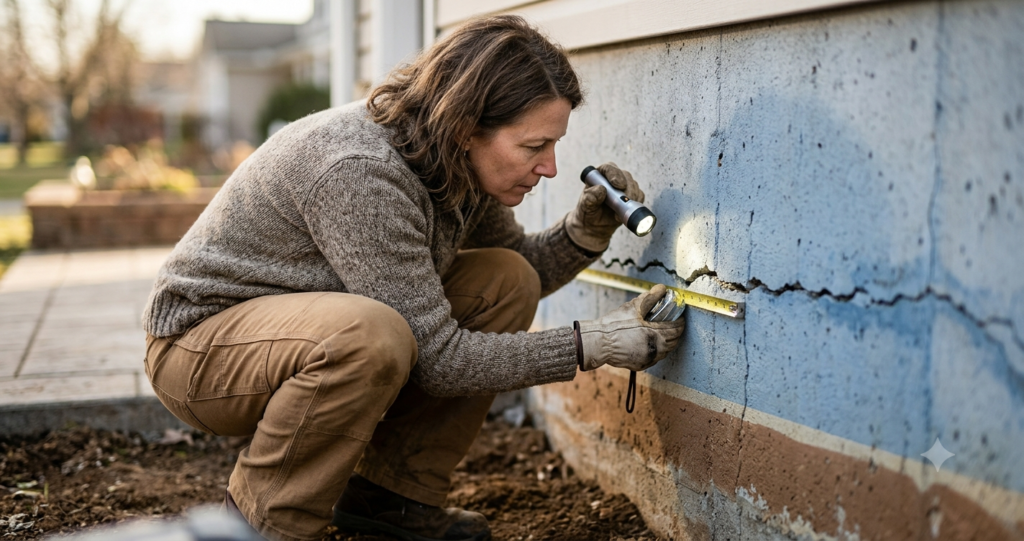
Photograph every crack with a coin or ruler next to it for scale, and note the date. Mark the ends of any crack lightly in pencil so you can see at a glance next time whether it’s grown. Check that exterior grading slopes away from the foundation rather than toward it, since water pooling against a foundation is one of the most preventable causes of new cracking. Walk the interior checking doors and windows for sticking, and jot down anything unusual. None of this fixes a foundation, but all of it turns your next conversation with a professional into a much shorter and more accurate one.
Does Insurance Cover Foundation Repair?
Usually not, and this catches people off guard. Standard home insurance is built around sudden, accidental damage — a burst pipe, a fallen tree — not the gradual settling that causes most foundation cracks. A foundation that cracks because of long-term soil movement is typically treated as a maintenance issue, the same way insurers generally won’t cover a roof that simply wore out with age.
There are exceptions. If a specific, sudden event — a plumbing leak, a sinkhole, unusually severe weather — caused or worsened the damage, that portion may be covered, which is exactly why the documentation habits above matter. Before assuming a repair is fully out of pocket, it’s worth understanding how your policy treats sudden versus gradual damage.
Full guide: does home insurance cover structural and water damage? →When to Stop Monitoring and Call Someone
A hairline vertical crack that hasn’t changed in two years can reasonably sit on a “monitor” list indefinitely. A horizontal or stair-step crack, a crack that’s visibly grown, or one appearing alongside sticking doors and sloping floors has crossed into “get this looked at” — and in that case, an engineer’s assessment before a contractor’s sales pitch is the safest next step.
Reader note: HomeDiagnosed gives general homeowner guidance. For structural, electrical, safety, or claim decisions, speak with a qualified professional or your insurer.
Read the crack before you fear the bill — most of them are cheaper and less serious than they look.