Home mold detection guide
How to Detect Mold in Your Home: Signs, Hidden Clues & Where to Look
If you suspect mold but are not sure where it is coming from, start with the house—not a test kit. The most useful first checks are visible changes, musty odors, moisture patterns, and the places where leaks or condensation tend to hide.
How Do You Know If Your House Has Mold?
You usually do not identify a mold problem from one clue alone. A better approach is to look for a pattern: moisture plus a visible, physical, or odor-related change. Mold may appear as spots or patches in different colors, but color alone does not tell you how serious a growth is. A persistent musty smell can also point to dampness or concealed growth even when no obvious patch is visible.
The strongest reason to investigate further is often not the mold itself—it is the water history. A roof leak, plumbing leak, window condensation, flooded area, damp basement, wet carpet, or repeated bathroom humidity creates the conditions mold needs to grow.
One small, dry mark
Photograph it, check whether the area is damp, and watch for change.
Recurring moisture or musty odor
Find the moisture source and inspect nearby materials before the problem spreads.
Active leak, extensive growth, or major water damage
Stop the water source if it is safe to do so and consider qualified professional help.
Common Signs of Mold in a House
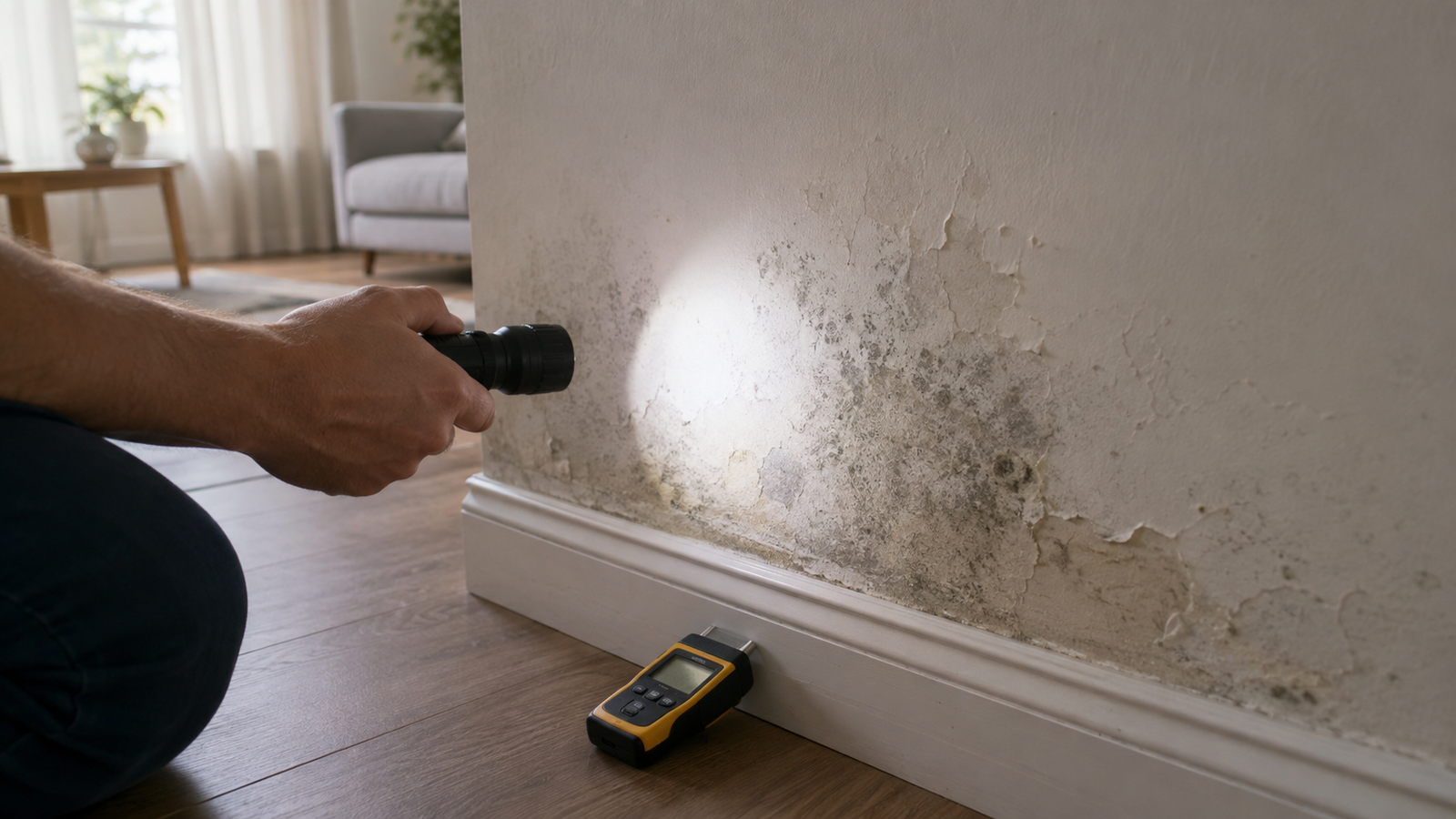
1. Visible spots, patches, or discoloration
Mold does not have one universal appearance. It may look black, green, gray, brown, white, or another color. What matters more than color is whether the area is associated with dampness, staining, a leak, or material that stays wet.
2. A persistent musty or earthy odor
A musty smell is an important clue, especially when it is strongest in one room, closet, cabinet, basement corner, or near a wall. An odor does not prove that mold is present, but it is a good reason to check for concealed moisture and hidden growth.
3. Water stains or recurring damp marks
Yellow, brown, or darkened areas on ceilings and walls can point to a current or past moisture problem. Even if a stain feels dry today, the leak or condensation that caused it may have affected nearby materials.
4. Peeling paint, bubbling finishes, or warped materials
Moisture can cause paint to bubble, wallpaper to loosen, drywall to soften, trim to swell, or wood products to warp. These changes are not automatically mold, but they help you locate areas where moisture has been active.
5. Condensation that keeps returning
Repeated condensation on windows, pipes, bathroom surfaces, or other cold materials signals excess moisture. That does not mean mold is already growing, but it creates a condition worth correcting before growth develops.
How to Check Your Home for Mold
If you are wondering how to check for mold in your house, use a simple room-by-room process instead of randomly searching every surface.
Start with the water history
List recent leaks, roof problems, plumbing repairs, appliance overflows, floods, wet carpet, basement seepage, or rooms that regularly feel damp.
Inspect visible surfaces in those areas
Use good lighting and look at ceilings, wall corners, baseboards, trim, window frames, under sinks, around tubs and showers, and behind movable furniture where practical.
Use smell as a location clue
If a musty odor is stronger in one location, narrow your inspection to that area and look for damp materials, staining, condensation, or a plumbing or exterior-water source.
Check whether moisture is still active
Feel for obviously damp surfaces where safe, look for condensation, and note whether a stain changes after rain, shower use, HVAC operation, or plumbing use.
Document what you find
Take dated photos, note the room and location, record any recent water event, and track whether the affected area is growing or returning after cleaning.
Where to Look for Mold in Your House
When you are trying to find mold in a house, start where moisture is most likely instead of treating every room equally.
Bathrooms
Check shower surrounds, caulk lines, ceilings, exhaust areas, under vanities, and around toilets or tubs.
Kitchens
Inspect beneath sinks, around supply and drain lines, near dishwashers, refrigerators, and exterior walls.
Basements & crawl spaces
Look for seepage, damp concrete, plumbing leaks, condensation, stored cardboard, and musty-smelling corners.
Windows & exterior walls
Watch for repeated condensation, stained trim, failed seals, or signs water is entering from outdoors.
Laundry areas
Check washer connections, drain areas, nearby walls, and dryer-vent conditions that contribute to indoor moisture.
HVAC-adjacent areas
Look around condensate drains, pans, nearby insulation, and areas where cooling equipment has leaked.
Attics
Check for roof leaks, staining, damp insulation, condensation, and ventilation problems where it is safe to access.
Previously wet rooms
Recheck any location affected by a burst pipe, storm, overflow, roof leak, or other water event.
Can Mold Be Hidden or Invisible?
Yes. Mold can grow in concealed areas where moisture is present, including behind finishes, beneath flooring, around plumbing penetrations, or near a leak that is not visible from the room side. This is why hidden mold detection depends on clues around the suspected area, not on cutting open a wall immediately.
Signs that justify a closer look
- A musty odor that returns after ventilation or cleaning
- A wall or ceiling stain that grows, darkens, or returns
- Soft, swollen, peeling, or warped building materials
- Known plumbing or roof leaks near the affected surface
- Repeated condensation in the same area
- Visible mold that keeps returning after the surface is cleaned
How to Trace Mold Back to a Moisture Source
Detecting mold is only half the job. Mold growth indoors points to a moisture problem, and that moisture source has to be corrected or the issue can return.
| Clue | Possible moisture source to investigate |
|---|---|
| Ceiling stain | Roof leak, plumbing above, HVAC condensate, or bathroom leakage |
| Lower wall or baseboard damage | Plumbing leak, exterior water entry, flood history, or wet flooring |
| Window condensation | High indoor humidity, low surface temperature, or ventilation problems |
| Musty cabinet under a sink | Supply-line drip, drain leak, loose fitting, or previous spill |
| Damp basement corner | Foundation seepage, grading/drainage issue, plumbing, or high humidity |
| Mold that keeps returning | Unresolved moisture, condensation, or a hidden wet material nearby |
EPA guidance emphasizes that moisture control is the key to mold control. Water-damaged materials should be dried promptly, and recurring leaks or condensation should be corrected rather than treated as a cosmetic issue.
Should You Test Your Home for Mold?
Testing and detecting are not the same thing. If you can already see mold or identify a clear moisture problem, a routine air sample may not tell you what to fix. CDC guidance does not recommend routine home mold testing, and NIOSH notes that visual inspection and musty-odor detection can be more useful than short-term air sampling for identifying dampness and mold problems.
Testing may still be considered in certain situations—for example, when a qualified professional is trying to answer a specific building question—but it should not replace a careful inspection for water and moisture.
Related guide planned: How to Test for Mold in Your House: DIY Tests vs. Professional Testing
When a Professional Mold Inspection Makes Sense
A homeowner can safely perform many visual and moisture checks, but some situations are better handled by a qualified mold or building professional.
- The suspected growth is extensive or keeps returning.
- There was significant flooding, sewage-contaminated water, or a long-running leak.
- You suspect mold inside a wall, ceiling, floor assembly, or another concealed building cavity.
- The moisture source is unclear after a basic inspection.
- The area involves HVAC equipment or other systems you should not dismantle yourself.
- Someone in the home has health concerns that need advice from a medical professional.
A useful inspection should focus on the source and extent of moisture, not merely on producing a mold-spore number without context.
What to Do If You Find or Suspect Mold
- Stop the moisture source. Fix leaks, seepage, or condensation problems as soon as practical.
- Document the area. Photograph staining, growth, material damage, and the suspected water source.
- Limit unnecessary disturbance. Do not aggressively scrape, sand, or open concealed areas simply to investigate.
- Dry wet materials promptly. EPA and CDC guidance emphasizes drying wet or damp materials quickly, generally within 24–48 hours when feasible.
- Choose cleanup based on the situation. Small surface growth and extensive water-damaged materials are not the same problem.
- Escalate when needed. For large, recurring, hidden, contaminated-water, or technically complex problems, contact an appropriate professional.
The bottom line
The best way to detect mold in your home is to follow the moisture. Start with what you can see and smell, then inspect places that have leaked, stayed damp, or developed condensation. If the signs point to a hidden or extensive problem, stop guessing and get the area evaluated before opening up the structure.
Frequently Asked Questions
How can I tell if my house has mold?
Look for visible spotting or discoloration, persistent musty odors, water stains, recurring condensation, peeling finishes, and damp materials. The combination of a moisture source and a recurring physical or odor clue is more useful than relying on color alone.
Can mold be present if I cannot see it?
Yes. Mold can grow in concealed damp areas. A persistent musty odor, recurring water damage, softened materials, or a known leak may justify further inspection even when no obvious patch is visible.
Where should I check for mold first?
Start with bathrooms, kitchens, basements, laundry areas, under sinks, around windows, near plumbing, around condensate areas, and anywhere that has leaked, flooded, or remained damp.
What does hidden mold look like?
Hidden mold may not be directly visible at all. Instead, you may see staining, peeling finishes, swollen materials, dampness, or other evidence that moisture is affecting a concealed area.
Can you detect mold without a test kit?
Often, yes. A careful visual inspection, moisture history, visible water damage, and musty odors can be useful first-line clues. Routine air sampling is not recommended by CDC as a general way to determine whether a home has a mold problem.
Should I test for mold if I can already see it?
In many situations, routine testing is unnecessary when mold is visibly present. The practical priority is usually to identify and correct the moisture source and address the growth safely.
How do I find the source of mold in my home?
Work backward from the affected area. Check nearby plumbing, roof or window leaks, exterior water entry, condensation, HVAC condensate, flood history, and indoor humidity. A recurring mold problem usually points to moisture that has not been fully corrected.
Authoritative Sources
This guide is based on homeowner-focused mold and moisture guidance from U.S. public-health and environmental agencies.